
ROBOR Compensation: What Are the Chances Following the Competition Council's Decision
21 September 2026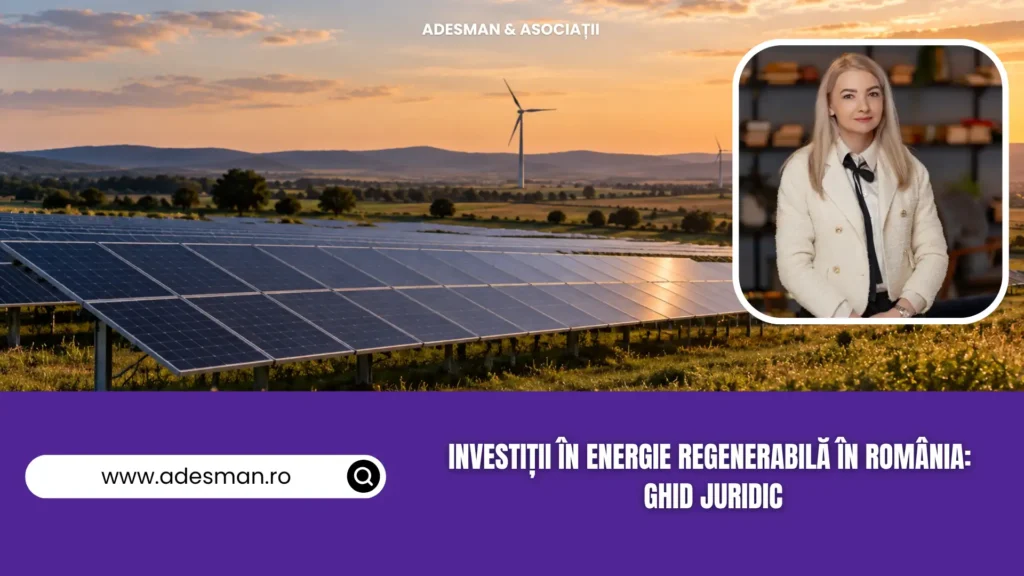
Renewable energy investments in Romania: land, grid connection and authorisation
Romania remains an attractive market for investments in renewable energy, particularly in solar energy, onshore wind energy and energy storage. However, the development or acquisition of a renewable energy project requires careful coordination between land rights, urban planning and construction requirements, grid connection, environmental permitting and ANRE authorisation.
Recent legislative amendments, including the new regulatory framework in Romania concerning urban planning and construction and the introduction, from 2026 onwards, of a competitive mechanism for grid capacity allocation, make conducting an early-stage legal due diligence all the more important for investors.
Securing land for renewable energy investments
According to the Code for Spatial Planning, Urbanism and Construction, which came into force in August 2026, renewable energy projects fall into the category of engineering works, as they constitute energy infrastructure.
This classification is relevant to the authorisation process. In particular, the urban planning certificate for carrying out engineering works can be requested and issued without the applicant holding a principal in rem right over the land in question. Consequently, the developer of a renewable energy project is not obliged to hold ownership rights over the land related to the project or a right of superficies at the time of obtaining the urban planning certificate.
However, prior to carrying out the construction works, the developer must secure the rights to the land required for the issuance and implementation of the building permit.
Before securing a site, investors should check not only the title deeds and any encumbrances, but also cadastral status, land use category and agricultural regime, access rights, urbanistic restrictions and the possibility of using the land both for the project and for the infrastructure required for its grid connection.
2. Agricultural land located outside built-up areas
Numerous renewable energy projects in Romania are developed on agricultural land located outside built-up areas. Law No. 18/1991 establishes a specific regime that allows, subject to the fulfilment of the conditions provided for by law, the development on certain categories of agricultural land of solar and wind energy production capacities, electricity storage units, transformer stations and related infrastructure, generally within the legal limit of 50 hectares.
The project's development may require the permanent or temporary withdrawal of the relevant area from agricultural use.
Romanian legislation also permits, in certain situations, dual land use of agricultural land for both farming activities and the generation of electricity from renewable sources. This regime may allow the removal from agricultural use of only the area actually occupied by the energy infrastructure, while the remaining area continues to be used for agricultural purposes.
3. Grid connection and ATR
Grid connection is increasingly becoming one of the main development risks for renewable energy projects in Romania.
The general procedure is regulated by theANRE Regulation approved by Order No. 59/2013, as subsequently amended and supplemented. This generally involves submitting the grid connection application, establishing the connection solution, issuing the Technical Connection Permit (ATR), concluding the grid connection agreement, building and commissioning the connection installations and, finally, issuing the grid connection certificate.
The ATR establishes the technical conditions under which the project can be connected to the public electricity grid.
Therefore, for investors purchasing a project, the mere existence of a grid connection technical permit is not enough. Due diligence should also analyse its validity, approved capacity, connection point, grid reinforcement works, costs, guarantees and implementation deadlines.
4. The new network capacity allocation mechanism
A particularly important development for investors is the introduction of the network capacity allocation mechanism for relevant projects with an installed capacity of at least 5 MW, applicable from 1 January 2026.
According to the methodology approved by ANRE Order No. 53/2024, the available network capacity for projects falling within its scope is allocated through a competitive mechanism.
This means that access to grid capacity must now be treated as a key investment risk rather than merely a technical matter related to the authorisation process.
Investors should establish from an early stage whether the project falls under the incidence of the capacity allocation mechanism and analyse the available capacity, the stage of the allocation process, applicable payments and financial guarantees, the connection schedule, as well as the consequences of failing to comply with the imposed development milestones.
This aspect is particularly relevant when acquiring projects presented as „ready-to-build” or at an advanced stage of development: land rights and permits have limited value if the project does not have a viable and legally secure grid connection solution.
5. ANRE authorisation and licensing
Grid connection is distinct from the authorisation and licensing regime managed by the National Regulatory Authority for Energy (ANRE).
According to Law no. 123/2012, projects that exceed the threshold stipulated by the law require the obtaining of a establishment permits, while projects that fall under the legal exemption are subject to the applicable notification regime.
The commercial exploitation of the generation capacity is subsequently subject to the applicable ANRE licensing requirements.
Therefore, investors should ensure that the steps regarding the land, construction, grid connection and ANRE authorisation they are coordinates, since delays or changes occurring in one of these processes can affect the validity or schedule of the others.
6. Authorisation from an environmental protection perspective
Renewable energy projects are subject to Romanian environmental protection legislation, which implements the relevant requirements of European Union law.
Depending on the location, size and characteristics of the project, the competent environmental protection authority may require the carrying out of an environmental impact assessments, of an appropriate assessment in relation to Natura 2000 sites and/or an assessment of the impact on water bodies.
Depending on the location, additional permits and approvals may be required, including in relation to protected areas, archaeological heritage, water management, aviation, defence infrastructure or land reclamation systems.
Any environmental constraints should ideally be identified as early as the stage of site selection and legal due diligence, and not after significant project development costs have already been incurred.
7. Support schemes and tax aspects
Romania has implemented several support mechanisms for renewable energy investment, including Contracts for Difference (CfD) scheme and funding opportunities available within European and national programmes, including via the Modernisation Fund.
These mechanisms can significantly improve the economic parameters of a project, but eligibility and the granting of support are subject to the rules of each scheme and should not be considered as automatically available for all renewable energy projects.
Similarly, Romanian law does not provide for a general tax exemption simply because a project produces energy from renewable sources. Investors should analyse the tax implications of the specific investment structure, including corporation tax, VAT, local taxes and duties, as well as the tax treatment of the acquisition and financing structure. For recent developments regarding taxation in the energy sector, please also see the Adesman & Asociații analysis regarding Energy Transition Fund.
Key takeaways for international investors
A renewable energy project in Romania should not be assessed solely by reference to secured land or permits already obtained.
For investors analysing renewable energy investments in Romania, the essential question is whether the project has a coherent and bankable development pathenforceable and adequate land rights, a viable situation from the perspective of urban planning and the agricultural land regime, a secure grid connection capacity or one that can be realistically obtained, valid environmental and construction permits, as well as a clear path towards ANRE authorisation and commercial operation.
Carrying out early-stage coordinated legal due diligence on all these matters can enable the identification of critical development risks before committing significant capital and can substantially contribute to the project's bankability and its preparation for a potential transaction.
Frequently asked questions about renewable energy investments in Romania
Can a foreign investor develop or acquire a renewable energy project in Romania?
Yes. Foreign investors can develop or acquire renewable energy projects in Romania, including photovoltaic, wind and energy storage projects. Depending on the structure and value of the transaction, the activities of the target company and other relevant circumstances, the investment may be subject to additional requirements, including those regarding investment screening and the FDI regime.
Is it necessary for the developer of a photovoltaic or wind farm to be the landowner?
No. The developer does not need to be the landowner at all stages of the project. Other rights that permit the development and exploitation of the project may also be used, under the conditions provided by law.
Under the current framework regarding spatial planning, urbanism and construction, for engineering works the urban planning certificate may be requested and issued without the applicant holding a principal real right over the land. However, in order to carry out the works, the right over the land necessary for authorising and executing the project must be secured.
Can a photovoltaic park be built on extra-urban agricultural land?
Under certain conditions, yes. Law No 18/1991 allows the installation of certain renewable energy production capacities and related infrastructure on certain categories of agricultural land located outside built-up areas, subject to the conditions and limits provided by law, including, under the relevant regime, the 50-hectare limit.
În funcție de proiect și de teren, poate fi necesară scoaterea definitivă sau temporară din circuitul agricol. În anumite situații este permisă și utilizarea duală a terenului pentru activități agricole și producerea energiei electrice din surse regenerabile.
Ce este ATR-ul și de ce este important pentru un proiect de energie regenerabilă?
ATR-ul – Avizul Tehnic de Racordare – stabilește condițiile tehnice în care proiectul poate fi racordat la rețeaua electrică de interes public.
Pentru un investitor, simpla existență a unui ATR nu este suficientă pentru evaluarea situației racordării. Analiza poate include, printre altele, valabilitatea ATR-ului, puterea aprobată, punctul de racordare, eventualele lucrări de întărire a rețelei, costurile și garanțiile asociate, precum și termenele și obligațiile care trebuie respectate pentru implementarea racordării.
Cum se alocă în 2026 capacitatea rețelei pentru proiectele de minimum 5 MW?
Pentru proiectele care intră în domeniul de aplicare al metodologiei aprobate prin Ordinul ANRE nr. 53/2024, capacitatea disponibilă a rețelei este alocată prin mecanismul concurențial aplicabil începând cu 1 ianuarie 2026.
În consecință, pentru proiectele vizate de acest regim, analiza juridică și investițională trebuie să ia în considerare nu numai existența infrastructurii de rețea, ci și accesul efectiv la capacitate, stadiul procedurii de alocare, costurile și garanțiile aferente, precum și termenele aplicabile proiectului.
Este suficient ca un proiect să aibă ATR pentru a fi considerat „ready-to-build”?
Nu în mod necesar. „Ready-to-build” nu reprezintă, prin el însuși, o garanție că toate condițiile juridice, tehnice și administrative necesare începerii construcției sunt îndeplinite.
În cadrul unui due diligence trebuie verificată situația concretă a proiectului, inclusiv drepturile asupra terenurilor, urbanismul, autorizația de construire, situația racordării și a capacității de rețea, autorizațiile de mediu, autorizarea ANRE și eventualele condiții, termene sau obligații încă neîndeplinite.
Ce autorizații ANRE sunt necesare pentru un proiect de energie regenerabilă?
Regimul aplicabil depinde de caracteristicile proiectului și de pragurile prevăzute de legislația în vigoare. Legea nr. 123/2012 reglementează autorizația de înființare pentru proiectele care depășesc pragul legal aplicabil, iar proiectele care beneficiază de excepția prevăzută de lege sunt supuse regimului corespunzător de notificare.
Exploatarea comercială a capacității de producere este, separat, supusă cerințelor de licențiere ANRE aplicabile.
Ce ar trebui verificat înainte de achiziția unui proiect de energie regenerabilă în România?
Un due diligence juridic al unui proiect de energie regenerabilă poate acoperi, în funcție de structura tranzacției, societatea de proiect și situația corporativă a acesteia, drepturile asupra terenurilor, urbanismul și construirea, racordarea la rețea și ATR-ul, capacitatea de rețea, autorizațiile ANRE, aspectele de mediu, contractele relevante, finanțarea, litigiile și eventualele cerințe privind examinarea investiției.
În cazul proiectelor aflate într-un stadiu avansat de dezvoltare, o atenție particulară trebuie acordată și termenelor, milestones-urilor, garanțiilor și condițiilor de care depinde menținerea drepturilor deja obținute.
Acest material are caracter general și exclusiv informativ și nu constituie consultanță juridică cu privire la un anumit proiect sau o anumită investiție. Aplicarea cadrului juridic depinde de caracteristicile fiecărui proiect și de legislația și reglementările în vigoare la momentul analizei.