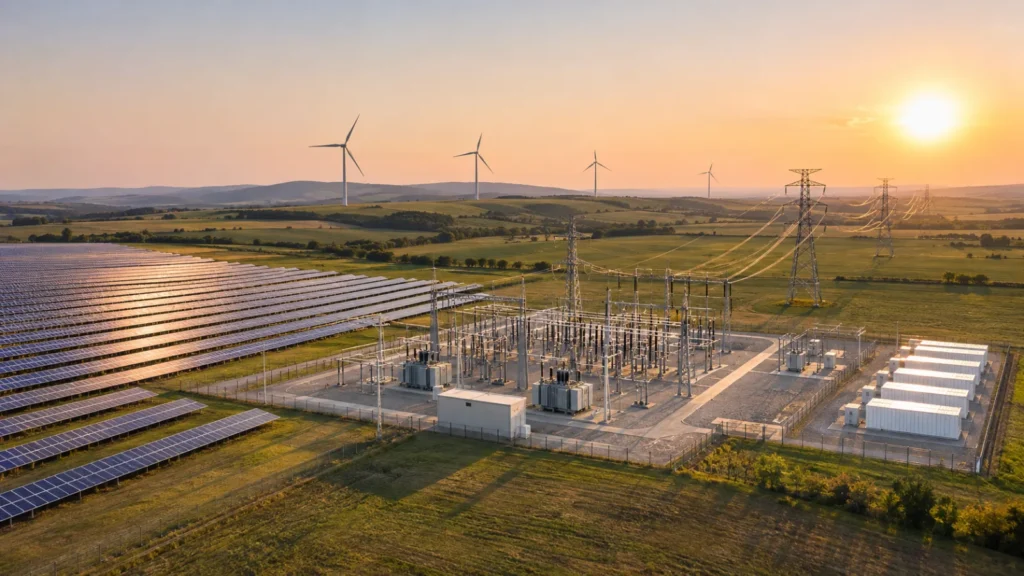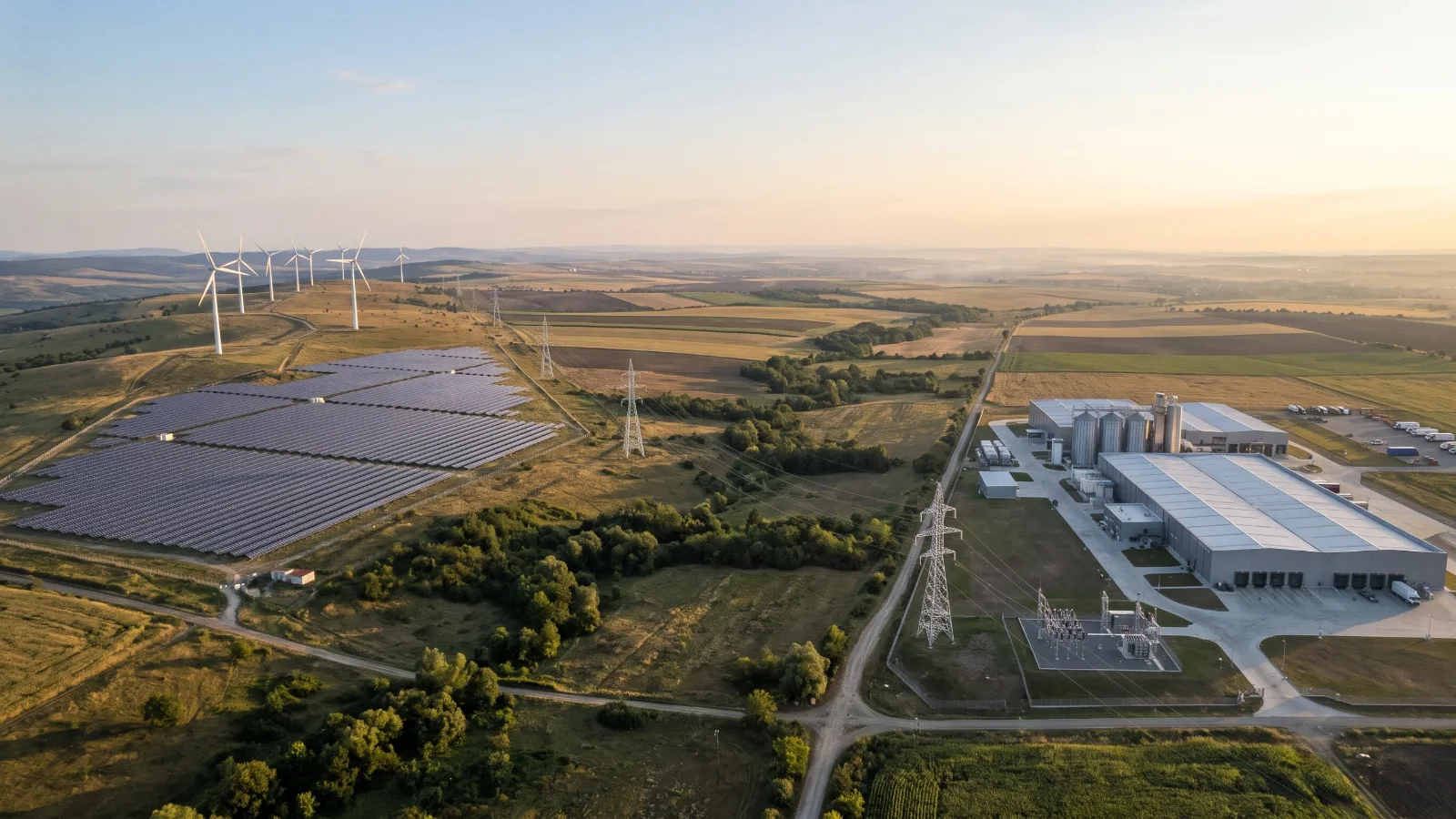
A power purchase agreement (PPA) is a long-term contract under which a consumer, usually an industrial company or a large consumer, buys electricity directly from a generator at a price fixed at the outset for several years. The generator obtains predictable revenues, which are needed for bank financing, while the consumer locks in its energy cost and, if it receives the related guarantees of origin, can demonstrate that it uses renewable energy.
In Romania, directly negotiated PPAs were prohibited between 2012 and 2020, in order to prevent non-transparent or disadvantageous arrangements. Law no. 123/2012 on electricity and natural gas (“Law no. 123/2012”) required wholesale transactions to be concluded on the centralised markets administered by OPCOM (the Romanian Electricity and Natural Gas Market Operator – Operatorul Pieței de Energie Electrică și de Gaze Naturale), the operator of the power exchange. The prohibition was gradually removed, aligning the legislation with the European framework, and a PPA can now be freely negotiated on the wholesale market, subject to the rules of the Romanian Energy Regulatory Authority (ANRE) (Autoritatea Națională de Reglementare în Domeniul Energiei) and of the European energy market.
PPAs may be physical, where the electricity is actually delivered to the buyer, or virtual/financial, where no electricity is delivered and the parties pay each other only the difference between the fixed price and the market price.
This guide sets out the legal framework in force on 24 November 2026, the types of PPA, the interaction with the contracts for difference (CfD) support scheme and the clauses that lenders review.
1. Legal framework: from prohibition to freely negotiated contracts
Government Emergency Ordinance (GEO) no. 74/2020 permitted directly negotiated PPAs for capacities commissioned after 1 June 2020, and Law no. 155/2020 amending and supplementing Law no. 123/2012 introduced several exceptions to the prohibition. Art. 23 was subsequently reworded by Government Emergency Ordinance no. 143/2021 (“GEO no. 143/2021”), which transposed Directive (EU) 2019/944 on common rules for the internal market for electricity. Accordingly, since 31 December 2021 (the entry into force of GEO no. 143/2021), any generator may conclude directly negotiated PPAs, regardless of the commissioning date of the capacity.
In its current wording, art. 23 of Law no. 123/2012 provides that:
- wholesale market transactions include direct bilateral transactions, transactions resulting from auctions on organised markets and import and export transactions [art. 23(2)];
- long-term supply contracts may be negotiated over the counter, in compliance with Union competition rules [art. 23(4)];
- participation in any electricity market is voluntary [art. 23(12)].
The Law is supplemented by Regulation (EU) 2019/943 of the European Parliament and of the Council of 5 June 2019 on the internal market for electricity (“Regulation (EU) 2019/943”), directly applicable since 1 January 2020. It was amended by Regulation (EU) 2024/1747 of the European Parliament and of the Council of 13 June 2024 amending Regulations (EU) 2019/942 and (EU) 2019/943 as regards improving the Union’s electricity market design (“Regulation (EU) 2024/1747”). The new art. 19a requires Member States to promote PPAs by removing unjustified barriers and to coordinate instruments, such as market-based guarantee schemes, that reduce the risk of a buyer failing to pay.
From an ANRE perspective, the generator needs a construction authorisation (autorizație de înființare) and a generation licence if the capacity exceeds 1 MW. Capacities of up to 1 MW may be operated commercially without a licence [art. 10(1)(b) of Law no. 123/2012]. To sell electricity to final customers, the generator, as a rule, also needs a supply licence. The exception is customers supplied directly from the generator’s own installations or networks or located in their vicinity, under the conditions laid down by ANRE [art. 10(6)]. For this reason, many PPAs with grid-connected consumers are concluded through a licensed supplier, which takes the electricity from the generator and delivers it to the consumer (a “sleeved” PPA).
Each energy market participant is financially responsible for the imbalances it causes, i.e. for the differences between the notified electricity and the electricity actually generated or consumed (art. 21 of Law no. 123/2012), and may delegate this responsibility to a balance responsible party (BRP) (PRE). The PPA must expressly provide who bears the costs of the imbalances it generates on the electricity market. This is an important point to negotiate.
2. Physical PPA: on-site, off-site and sleeved
In a physical PPA, the electricity is actually delivered to the buyer. The structures differ according to where the plant is located and who takes the electricity from the generator:
- On-site PPA: the plant belongs to a third party, usually a developer, and is located at the consumption site (for example, photovoltaic panels on the factory roof) or connected to the consumer by a direct line. If the plant belongs to the consumer, this is not a PPA but self-consumption. The generator may sell without a supply licence to customers supplied directly from its installations or networks or located nearby, under the conditions laid down by ANRE [art. 10(6) of Law no. 123/2012]. The technical connection conditions and the direct line regime should be checked with the network operator and with ANRE;
- Off-site PPA: the plant is at another location and the electricity is transported to the consumer through the public grid. If the generator holds a supply licence, the PPA is a supply contract and the consumer remains a final customer. If it does not, the consumer can buy directly only by acting on the wholesale market itself: it registers as a participant, submits physical notifications of the quantities and assumes responsibility for imbalances or transfers it to a balance responsible party. In all other cases, the sleeved structure is used;
- Sleeved PPA (the most common form of off-site PPA): a licensed supplier takes the electricity from the generator and delivers it to the consumer, covering profile differences with electricity bought on the market and ensuring balancing. Two contracts are usually signed: one between the generator and the supplier, and another between the supplier and the consumer.
For off-site and sleeved PPAs, the generator’s grid access is a prerequisite. The rules on the allocation of grid capacity and the guarantees required by ANRE are discussed in our article on the grid capacity allocation auction.
3. Financial (virtual) PPA: a contract for difference between private parties
In a virtual PPA, no electricity is delivered. The generator sells its electricity on the market, and the consumer buys its electricity from its usual supplier. The parties agree a price (strike price) and periodically settle the difference between it and the market price, usually the day-ahead market price in the generator’s bidding zone: if the market price is lower than the strike price, the buyer pays the difference; if it is higher, the generator pays it. The contract also sets the settled volume (actual generation or a fixed profile) and what happens in hours with negative prices.
The generator and the consumer may be in different bidding zones or Member States, without an intermediary supplier. In that case, the buyer bears the basis risk: the difference is settled at the price in the generator’s zone, while the buyer pays for its electricity at the price in its own zone.
A contract settled exclusively in cash and linked to the price of electricity may be classified as a financial derivative. In that case, Directive 2014/65/EU on markets in financial instruments (“MiFID II”), transposed in Romania by Law no. 126/2018, and Regulation (EU) No 648/2012 on OTC derivatives (“EMIR”) may apply, with reporting obligations and, above certain thresholds, clearing obligations. The classification depends on the specific structure and must also be analysed in the buyer’s state of residence.
4. State CfDs and PPAs: why they do not overlap
A contract for difference or CfD contract is a private-law contract concluded between the CfD counterparty and the CfD beneficiary, on the basis of which CfD difference payments are made in accordance with the relevant CfD scheme.
Government Decision (GD) no. 318/2024 approving the general framework for the implementation and operation of the contracts for difference support mechanism for low-carbon technologies (“GD no. 318/2024”) introduced the CfD scheme in Romania. The Ministry of Energy approves the scheme and organises the auctions, Transelectrica conducts them as scheme operator, and OPCOM is the counterparty to the contracts concluded with the beneficiary. According to the specialist press, the first round (December 2024) awarded more than 1,500 MW of wind and solar PV, the second (August 2025) approximately 1.4 GW of solar PV, and the third (December 2025), dedicated to wind, approximately 316 MW.
For an investor, the key rule is the one in art. 12(4) and (5) of GD no. 318/2024: electricity generated by the capacity benefiting from a CfD is delivered to the grid and sold only on organised markets, except for technological own consumption. Selling outside organised markets is prohibited on pain of exclusion from the scheme: the CfD contract terminates and the beneficiary repays the CfD payments relating to the quantities so sold [art. 12(6)]. Consequently, the same capacity cannot benefit simultaneously from a CfD and a directly negotiated PPA. Whether a project can be split between a CfD portion and a PPA portion must be checked against the rules of each round and the CfD contract.
At European level, art. 19a(5) of Regulation (EU) 2019/943 allows support schemes to also admit projects that reserve part of their electricity for sale under a PPA, provided that this does not affect competition on the market, in particular where the two parties involved in the relevant power purchase agreement are controlled by the same entity. Art. 19d requires direct price support for new capacities (wind, solar, geothermal, run-of-river hydro and nuclear) to take the form of two-way CfDs for contracts concluded from 17 July 2027. In December 2025, the European Commission published guidance on these contracts, which also addresses their combination with PPAs.
Are you negotiating a PPA for a solar PV or wind farm, or for a factory’s consumption? We analyse the contract structure and risk allocation before signing.
5. Guarantees of origin
A guarantee of origin (GO) is the electronic document whose sole function is to provide a final customer with proof that a given share or quantity of energy supplied to it was produced from renewable sources. The standard size of a guarantee of origin is 1 MWh. GOs allow the consumer to report its consumption as renewable, including in sustainability reporting. The current regime is based on Government Decision no. 1232/2011 and art. 19 of Government Emergency Ordinance no. 163/2022 (“GEO no. 163/2022”).
Government Emergency Ordinance no. 59/2025, amending GEO no. 163/2022, reforms the system: a GO is valid for 12 months from generation and expires after 18 months if not cancelled, ANRE is to adopt regulations on the issue, transfer and cancellation of GOs, and a standardised market is expected to be fully operational from 1 January 2027. The GO regime now also covers nuclear energy, renewable gases, hydrogen and renewable heat.
ANRE has obtained observer status in the AIB (Association of Issuing Bodies), but must meet several conditions to become a full member of the AIB; until full accession, a foreign buyer must check whether Romanian GOs can be used in its own state. Generators benefiting from support schemes, including CfDs, are subject to separate GO rules in order to avoid double financing.
The contract must expressly provide whether the GOs are transferred to the buyer, in what quantity, on what date and what compensation is payable if they are not issued or transferred on time. In a sleeved PPA, the same clauses must be aligned in both contracts, the one between the generator and the supplier and the one between the supplier and the consumer.
6. Price, volume and term
Price
- fixed: the same price for the entire term or with an annual escalation set at the outset; this is the structure preferred by lenders, as it offers greater revenue certainty;
- indexed: the price follows an index (inflation, market price) according to an agreed formula; inflation indexation preserves predictability;
- with a floor and a cap (cap and floor): the price follows the market but does not fall below a minimum that protects the generator and does not rise above a maximum that protects the consumer.
Volume
- pay-as-produced: the buyer takes all or a share of the output as it is generated; the volume risk (solar generation at midday, constant consumption) remains with the buyer;
- baseload or fixed profile: the generator delivers a constant quantity per hour, or according to a pre-agreed curve, and buys any shortfall on the market; the volume risk passes to the generator;
- whatever the structure, the contract must also regulate: minimum guaranteed volumes, penalties for non-delivery and rules for negative prices.
The usual term for a PPA supporting a financing, based on market practice, is 10–15 years, aligned with the loan tenor. For new projects, the contract provides for a commissioning deadline (long-stop date), after which the buyer may terminate the contract.
7. Imbalances, curtailment, change in law and force majeure
- Imbalances and profiling: the contract determines who the balance responsible party is, who notifies the generation schedules and who bears the cost of deviations, i.e. the difference between the generation profile and the consumption profile.
- Curtailment: Transelectrica or the distribution operator may limit generation for grid security. Non-market-based redispatching is financially compensated under art. 13 of Regulation (EU) 2019/943. The contract must provide whether electricity not delivered for this reason is treated as delivered (deemed energy) and who receives the compensation. Separately, the contract regulates economic curtailment, i.e. the voluntary shutdown of the plant in hours with negative prices.
- Change in law: in 2022–2024 Romania applied price caps and windfall contributions. The Constitutional Court subsequently declared the contribution unconstitutional. The clause defines the changes covered and the renegotiation or termination mechanism.
- Force majeure: grid limitations and curtailment are dealt with separately, since in most cases they do not meet the force majeure requirements of art. 1351 of the Civil Code.
8. Security, termination and bankability
The lender reviews in particular:
- the buyer’s payment security: a bank letter of guarantee, a parent company guarantee (parent guarantee) or a collateral account, to be topped up if the buyer’s rating falls;
- the termination events and the termination payment, usually calculated as the market value of the remaining contract;
- the direct agreement between the lender, the generator and the buyer, under which the bank can cure a default and transfer the contract to a new operator; accordingly, the PPA must allow the assignment of the contract or of the receivables to the lender, or the creation of security over the rights under the contract, without the buyer’s consent;
- governing law and dispute resolution: international arbitration is frequently used for foreign parties (for example, the ICC or the Court of International Commercial Arbitration attached to the Chamber of Commerce and Industry of Romania); physical PPAs are usually governed by Romanian law. Regardless of the law chosen, Romanian market rules apply in any event to physical deliveries in Romania. For disputes between market participants, there is also a dispute resolution procedure before ANRE.
Projects sold before commissioning undergo due diligence in which the PPA is one of the main documents.
9. REMIT and VAT
Regulation (EU) No 1227/2011 on wholesale energy market integrity and transparency (“REMIT”), as amended by Regulation (EU) 2024/1106, applies to wholesale energy products. A PPA may fall within this category, with reporting obligations to ACER (the European Union Agency for the Cooperation of Energy Regulators) and the prohibition of market abuse.
For VAT purposes, the reverse charge applies to supplies of electricity to a taxable dealer established in Romania [art. 331(2) of Law no. 227/2015 on the Fiscal Code (the “Fiscal Code”)], until 31 December 2026. A dealer is a person whose principal activity in respect of the electricity purchased is resale and whose own consumption is negligible. An industrial consumer using the electricity for its own business is not, as a rule, a dealer in this sense, so the invoice includes VAT under the normal regime. In a sleeved PPA, the supply from the generator to the supplier is subject to the reverse charge, while the supply from the supplier to the consumer bears VAT under the normal regime.
10. PPAs for projects with storage
Hybrid projects, combining a solar PV farm with battery energy storage systems (BESS), can offer the buyer a more stable delivery profile, including in the evening. Storage reduces profile risk but complicates the volume and metering clauses.
The permitting and market aspects of batteries are covered in our article on BESS projects in Romania.
What you should do
- Determine the PPA structure: on-site physical PPA, direct or sleeved off-site PPA, or virtual PPA, depending on the place of consumption, the licences you hold and your state of residence.
- Check whether the project has or will have a CfD.
- Check the buyer’s creditworthiness and set the payment security, including the obligation to top it up if the rating falls.
- Request the lender’s requirements (security, direct agreement, termination payment) from the very start of negotiations and include them in the contract.
- For new projects, set the scheduled commissioning date and the long-stop date, as well as the compensation for delay.
- Expressly determine who the balance responsible party is, who bears the imbalances and how curtailment and negative prices are treated.
- Include a change in law clause covering new taxes, price caps, sales obligations and changes to the VAT regime.
- Regulate the transfer of guarantees of origin and monitor the ANRE regulations adopted under GEO no. 59/2025.
- For projects with battery storage, regulate the origin of the electricity, metering and the priority of use of the storage capacity.
- For a virtual PPA, check its classification under MiFID II, EMIR and REMIT before signing.
Frequently asked questions
Is a directly negotiated PPA legal in Romania?
Yes. Art. 23(4) of Law no. 123/2012 allows directly negotiated bilateral transactions on the wholesale market, and long-term supply contracts may be negotiated over the counter, in compliance with competition rules. The exception is electricity generated by a capacity with a CfD.
What is the difference between a physical PPA and a virtual PPA?
In a physical PPA, the electricity is delivered to the buyer, directly or through a supplier. In a virtual PPA, the parties settle only the difference between a fixed price and the market price, and the contract may be a financial derivative.
Can a company without an ANRE licence conclude a PPA?
Yes, usually through the sleeved structure, in which a licensed supplier takes the electricity from the generator and delivers it to the consumer.
How long does a PPA last?
For new bank-financed projects, the usual term is 10–15 years. The law does not impose a minimum or maximum term.
Who receives the guarantees of origin under a PPA?
It depends on the contract. Usually, in a “green” PPA, the GOs are transferred to the buyer together with the electricity or, in a virtual PPA, separately. The GO regime is being changed by GEO no. 59/2025, and the standardised market is expected to be fully operational from 1 January 2027.
Adesman & Asociații assists generators, industrial consumers and lenders in negotiating PPAs, in dealings with ANRE and Transelectrica, and in energy litigation and arbitration. Learn more about our energy law practice and about renewable energy investments in Romania.
Are you preparing a PPA or the financing of a renewable project? Speak to our energy law team.
This material is for general information purposes only and does not constitute legal advice. The applicable legal regime must be analysed according to the specific circumstances of each contract and the legislation in force at the date of the analysis.